Why do remittance apps in Japan cap transfers at 1 million yen?
The ¥1,000,000 (1 million yen) line is the cap for Type 2 funds transfer services (第二種資金移動業) under the Payment Services Act (資金決済法). A company that also holds Type 1 can go above it in some cases, but some of these companies keep personal transfers at ¥1,000,000. Each company's limits per period and the limits at the destination also apply on top.
The screens of apps and services for sending money abroad from Japan often say "up to ¥1,000,000 (1 million yen) per transfer". The companies did not each choose this number separately. For Type 2 funds transfer services (第二種資金移動業), the registration used by remittance providers that are not banks, the law sets the money that can be moved at one time at the equivalent of ¥1,000,000 or less. On the other hand, there is also a type called Type 1 (第一種) that can send more than ¥1,000,000, and which type is used differs by company and by product.
This article uses the text of the Payment Services Act (資金決済法) and its Enforcement Order, the Financial Services Agency (FSA) list of registered funds transfer service providers (as of August 31, 2026) and each company's official pages. It explains where the ¥1,000,000 line comes from and how many other layers of rules decide the amount you can send. Each company's limits can change, so check the company's app or official page before you actually send.
The ¥1,000,000 line comes from the "type" of funds transfer service
The Payment Services Act calls it "funds transfer service" (資金移動業) when a company other than a bank or similar institution sends money (exchange transactions, 為替取引) as a business, and it allows this only for companies registered with the Prime Minister (Article 2, paragraphs 2 and 3; Article 37). Many companies that run remittance apps are not banks but these funds transfer service providers (資金移動業者).
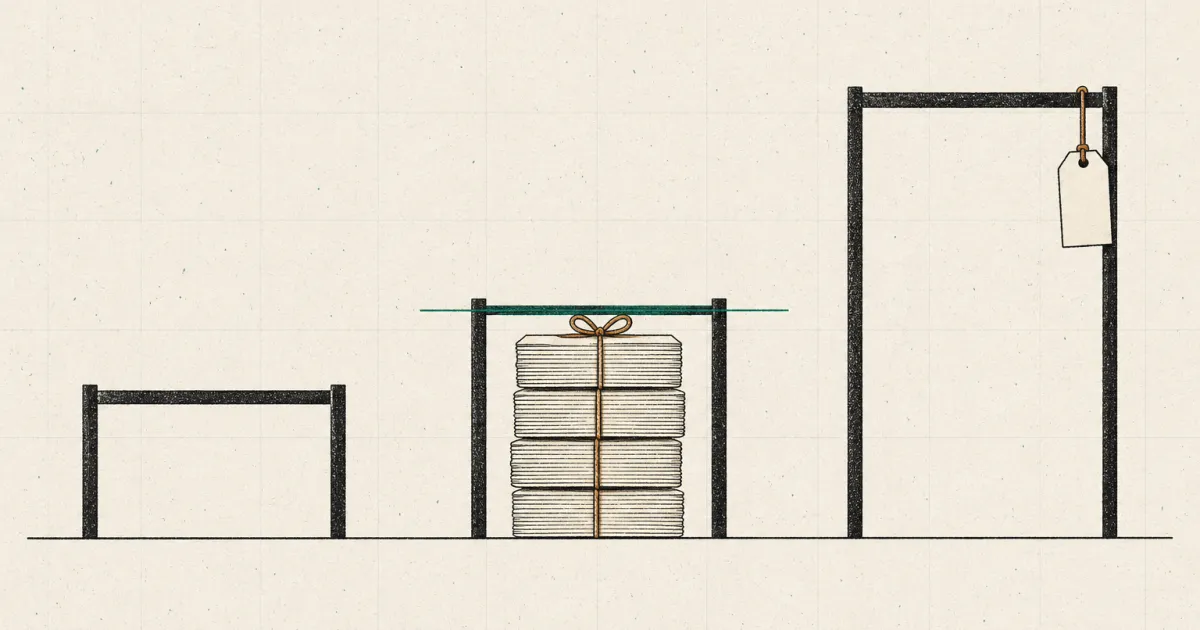
Funds transfer services are divided into three types by the amount that can be moved at one time (Article 36-2). The amounts themselves are written in the Enforcement Order, not in the Act: Type 2 is up to "an amount equivalent to one million yen" (百万円に相当する額) and Type 3 is up to "an amount equivalent to fifty thousand yen" (五万円に相当する額) (Enforcement Order, Article 12-2). Type 1 has no amount cap in the laws and regulations. In exchange, the company has to make a business implementation plan (業務実施計画) and get a separate authorization (Article 40-2).
| Type | Amount per transfer | Main rules |
|---|---|---|
| Type 1 (第一種) | No cap in the laws and regulations (the company may set a cap in its authorized business implementation plan) | Authorization of the business implementation plan (Article 40-2). The company cannot owe debts for which the amount, sending date and destination are not clear, and cannot owe debts beyond the period set by Cabinet Office Order, such as the period needed to process the transfer (Article 51-2) |
| Type 2 (第二種) | Equivalent of ¥1,000,000 or less | When the debt owed to one user is over ¥1,000,000, the company needs a system to check whether that money is going to be used for transfers (Cabinet Office Order, Article 30-2) |
| Type 3 (第三種) | Equivalent of ¥50,000 or less | The company cannot owe one user a debt over the equivalent of ¥50,000 (Article 51-3; Enforcement Order, Article 17-2) |
Articles checked on e-Gov Laws Search (October 2, 2026). Because the wording is "equivalent amount", a transfer in a currency other than yen is also judged by the amount converted into yen.
According to an FSA explanation, until the amended law took effect on May 1, 2021, all funds transfer service providers had a cap of ¥1,000,000 per transfer. The amendment kept the existing system as Type 2 and newly created Type 1 for transfers over ¥1,000,000 and Type 3 for transfers of around several tens of thousands of yen. Many of the "up to ¥1,000,000" notices you see today carry over this Type 2 cap as it is.
- Equivalent of ¥50,000The cap per transfer under Type 3. The debt that can be owed to one user is also up to the equivalent of ¥50,000.
- Equivalent of ¥1,000,000The cap per transfer under Type 2 (you can send up to exactly ¥1,000,000). Until April 2021, this was the cap for all funds transfer service providers.
- Amounts over ¥1,000,000Can only be handled under Type 1. Also, whether it is a bank or a funds transfer service provider, the company that sent the money files a Report of Overseas Remittances (国外送金等調書) with the tax office for each transfer (under a different law).
8 of 85 companies hold Type 1. Even with Type 1, personal transfers may stop at ¥1,000,000
The FSA list of registered funds transfer service providers (as of August 31, 2026) has 85 companies. Counting the column for the type of business, 77 companies hold Type 2 only, 7 companies hold both Type 1 and Type 2, 1 company holds Type 1 only, and there was no Type 3 company. In total, 8 companies hold Type 1.
Source: FSA list of registered funds transfer service providers (資金移動業者登録一覧; as of August 31, 2026 (Reiwa 8), retrieved October 8, 2026). The type of business column was counted by this site.
Show the figures as a table
| Type of business | Number of companies |
|---|---|
| Type 2 only | 77 companies |
| Type 1 and Type 2 | 7 companies |
| Type 1 only | 1 company |
| Type 3 | 0 companies |
Among the remittance services compared on this site, the table below shows the registered type of the 5 companies that are not banks, next to what each says about the amount an individual can send at one time. Holding Type 1 does not necessarily mean that individual users can send more than ¥1,000,000.
| Service | Registered type (FSA list) | Cap per transfer (company guidance) | How the company explains it |
|---|---|---|---|
| Wise | Type 1 and Type 2 (Director-General of the Kanto Local Finance Bureau No. 00040) | ¥1,000,000 or less is handled under Type 2, and amounts above that are switched to Type 1 automatically. Large transfers under Type 1 go up to the equivalent of ¥150,000,000 (150 million yen) | Explains the ¥1,000,000 line by linking it to the Type 2 licence |
| Instarem | Type 1 and Type 2 (Director-General of the Kanto Local Finance Bureau No. 00073) | Up to ¥1,000,000 per transfer (minimum ¥5,000) | "For regulatory compliance and the safety of transfers" (「規制の遵守と送金の安全のため」) |
| SBI Remit | Type 1 and Type 2 (Director-General of the Kanto Local Finance Bureau No. 00008) | Up to ¥1,000,000 per transfer | "Based on laws and regulations" (「法令に基づき」). Announced that it plans to use Type 1 for a new service for companies |
| Smiles | Type 2 (Director-General of the Kanto Local Finance Bureau No. 00044) | Up to ¥1,000,000 per transfer | "Based on the Payment Services Act" (「資金決済に関する法律に基づき」) |
| DCOM | Type 2 (Director-General of the Hokuriku Local Finance Bureau No. 00001) | In principle, up to ¥1,000,000 per transfer | The terms do not mention the law |
Registered types are from the FSA list (as of August 31, 2026). Caps are from each company's official pages and terms (checked October 2–8, 2026). Instarem's Japan page says Type 1 and Type 2 at the bottom of the page, but says Type 2 in the answer in its frequently asked questions.
SBI Remit announced that it received authorization of its Type 1 business implementation plan on July 21, 2026. The announcement says it is preparing "Remit Prime" (レミットPrime), a service for companies that can send up to ¥1,000,000,000 (1 billion yen) per transfer, and gives the start time as "planned for the future" (今後予定). Its remittance page for individuals still said up to ¥1,000,000 per transfer as of October 8, 2026. Even when the type in the registration list changes, the amount an individual can send does not increase right away, so check each company's guidance.
Above ¥1,000,000, paying from a balance and the handling of the arrival estimate change
Wise, which holds both Type 1 and Type 2, explains that for users registered with an address in Japan it handles a transfer under Type 2 if it is ¥1,000,000 or less and under Type 1 if it is over ¥1,000,000, and that the choice is made automatically. However, a transfer over ¥1,000,000 cannot be paid from the Wise account balance. Adding money to the account is also up to ¥1,000,000 at one time, and withdrawing is up to ¥1,000,000 at one time.
For a transfer under Type 1, you agree to three things before sending: the recipient, the amount and the estimated time until arrival. Wise says that a Type 1 transfer that arrives later than the first estimate has to be refunded, not given a new estimate, and it explains the reason as Type 1 regulations. But it also writes that only a very small share of transfers go past the estimate.
This explanation matches Article 51-2 of the Payment Services Act, which prohibits a Type 1 company from owing debts for which the amount, sending date and destination are not clear, and also from owing debts beyond the period set by Cabinet Office Order, such as the period needed to process the transfer. However, the Cabinet Office Order leaves some room: it allows up to 2 months when a certain safeguarding arrangement is in place, and a period for resolving causes that are not the provider's fault, such as wrong recipient details, can be added. In other words, "if it is late, it is refunded in every case" is not the wording of the law itself. It is how Wise operates. Wise itself does not cite an article number, and the link to the article is this site's reading.
The balance also has a cap. Wise applies to users registered with an address in Japan a holding limit equivalent to ¥1,000,000 across all currencies together, and gives the reason as Japanese regulations. The limit can be raised temporarily to a maximum of ¥20,000,000 for up to 6 months, but if the balance stays above the limit for 30 days or more, the account may be restricted. A Type 2 company has to set up a system to check whether money is going to be used for transfers when it owes one user a debt over ¥1,000,000 (Cabinet Office Order, Article 30-2), so the holding limit is thought to be related to this.
Apart from the legal cap, each company sets limits per period
Even when the cap per transfer is ¥1,000,000, it does not mean you can send many times in a row. Some companies set their own limits for periods such as 30 days, 1 month or 1 year. For example, SBI Remit calls the ¥1,000,000 per-transfer cap a "standard based on laws and regulations" (法令に基づく基準) and states clearly that, in addition to it, "our company independently" (当社は独自に) sets the following limits.
| Service | Limits per period and similar | Notes |
|---|---|---|
| SBI Remit | ¥2,000,000 within 90 days from the date of the first transfer after member registration, ¥1,500,000 in the most recent 30 days, ¥5,000,000 in the most recent 365 days, and up to 20 transfers per month | These are standard criteria. Different criteria may be set depending on the member's attributes and transfer history |
| DCOM | ¥2,000,000 per month, ¥3,500,000 per year | Both are "in principle". DCOM has no obligation to send the part that is over the limit |
| Smiles | May set an amount limit and a limit on the number of transfers individually for each user | Operated in line with laws and guidelines on anti-money laundering measures. Depending on the destination or the recipient, a transfer may not be possible regardless of the limit |
Checked on each company's official pages and terms (for SBI Remit, the Japanese page; the content of the English page does not match). Limits may change without notice.
These limits per period are not numbers set by law. Each company sets them as part of how it handles identity checks and anti-money laundering measures. Even a transfer of ¥1,000,000 or less may not be accepted if you have sent a lot recently. If you plan to send a large sum in several transfers, for example for a family member's school fees or moving costs, checking each company's limits per period first helps you avoid being stopped partway.
The destination side has separate limits too
The rules on the Japan side are not the only thing that decides the amount you can send. The regulations at the destination and the local partner that handles the payout also have limits, and if they are lower than the limit on the Japan side, they take priority. SBI Remit says that when an overseas partner sets its own limit, it follows that limit. Smiles also writes in its terms that when the laws of the receiving side set a limit, the lower one is the limit.
As a specific example, Wise states that for transfers to Korean won, from September 1, 2026 the amount that can be received changes with the recipient's residency status. A resident of South Korea can receive up to the equivalent of USD 100,000 per year (with no regulatory limit per transfer). A non-resident can receive up to the equivalent of USD 5,000 per transfer and up to the equivalent of USD 50,000 per year. Wise writes that, separately from this, limits on the Wise side or on the sending currency side may also apply.
- Japanese law (type of funds transfer service)Type 2 is up to the equivalent of ¥1,000,000 per transfer. Type 1 has no cap in the laws and regulations and can send within the scope of the authorized plan.
- Limits of each remittance serviceThe cap per transfer (some companies stop at ¥1,000,000 even with Type 1) and limits per period such as 30 days, 1 month or 1 year. Limits may also be set individually for each user.
- Limits at the destination and of the partnerRegulations at the destination and the limits of the local partner. Example: a non-resident recipient in South Korea can receive up to the equivalent of USD 5,000 per transfer (Wise guidance).
Overseas remittance by banks is outside the funds transfer service caps
Banks are not funds transfer service providers, so the Type 2 cap of ¥1,000,000 does not apply to them. This is because the Payment Services Act defines funds transfer service as a business of "persons other than banks and similar institutions" (銀行等以外の者). However, overseas remittance by banks also has limits that each bank sets. The table below shows the guidance for applying online.
| Bank | Stated limit | Additional notes |
|---|---|---|
| Rakuten Bank | No particular remittance limit is set | There is a system limit per transfer (the amount is not published) |
| MUFG Bank | Equivalent of ¥3,000,000 or less per transfer, equivalent of ¥3,000,000 or less in total per day, and equivalent of ¥5,000,000 or less in total per month (excluding fees) | Other restrictions may be set depending on the currency or the country or region. For Global Direct contract holders, only the limit of the equivalent of ¥5,000,000 or less per month applies |
| SMBC (Sumitomo Mitsui Banking Corporation) | Within ¥3,000,000 per day and within ¥5,000,000 per month | For some countries and regions, the total counted back 30 days from the acceptance date (that day included) has to be within ¥1,000,000, and the total counted back 365 days within ¥3,000,000 (the countries covered are not disclosed) |
All of these are limits for applying online. We have not checked the limits for transfers at a counter. Checked on each bank's official pages on October 3–8, 2026.
When you want to send more than ¥1,000,000 at one time, the candidates are a service that can send under Type 1, or a bank. But banks also have daily and monthly limits, and there are cases, such as SMBC, where the limit is lower only for some countries and regions. With any method, the conditions change depending on the destination.
What to check before sending around ¥1,000,000
Before sending a large amount, checking in the following order helps prevent the transfer being stopped partway or extra procedures being added.
- Is the amount ¥1,000,000 or less, or over it? If it is over, does the service accept transfers over ¥1,000,000 for individuals? (You cannot judge this only from whether it holds Type 1.)
- The service's limits per period (most recent 30 days, 1 month, 1 year and so on) and how much you have sent so far. Some services set limits individually for each user.
- Limits for each destination and each payout method (bank account, cash pickup and so on). In some places the limit changes with the recipient's residency status.
- If the amount is over ¥1,000,000: restrictions on the payment method (with Wise, you cannot pay from your balance) and what happens when the arrival estimate has passed (under Type 1, it may be refunded in some cases).
- For a transfer over ¥1,000,000, the company that sent the money files a Report of Overseas Remittances with the tax office. Have you already submitted your My Number?
This article does not suggest splitting a transfer into small parts to avoid a limit. The limits and the report are systems for user protection, anti-money laundering measures and proper taxation, and depending on how a transfer is split, it becomes subject to each company's limits and checks. If you have a reason to send a large sum, consult the remittance service or the bank in advance.
The ranking by total cost, which combines the fee and the exchange rate, also changes with the amount you send. To compare with your actual amount, enter the destination and the amount in the remittance cost comparison table.
See what your recipient gets after fees and the exchange rate in the comparison table for each destination.
Related pages
Sources
Figures, legal articles and provider rules in this article were checked on the official pages below. They may have changed after the verification date.
- e-Gov Laws Search: Payment Services Act (資金決済に関する法律), Article 2, paragraphs 2 and 3, and Article 37Verified 2026-10-02
- e-Gov Laws Search: Payment Services Act (資金決済に関する法律), Articles 36-2 and 40-2 / Enforcement Order of the Act, Article 12-2Verified 2026-10-02
- e-Gov Laws Search: Payment Services Act (資金決済に関する法律), Article 51-2 / Cabinet Office Order on Funds Transfer Service Providers (資金移動業者に関する内閣府令), Article 32-2Verified 2026-10-08
- e-Gov Laws Search: Cabinet Office Order on Funds Transfer Service Providers (資金移動業者に関する内閣府令), Article 30-2Verified 2026-10-02
- e-Gov Laws Search: Payment Services Act (資金決済に関する法律), Article 51-3 / Enforcement Order of the Act, Article 17-2Verified 2026-10-02
- Financial Services Agency: Access FSA No. 213 (explanation of the 2020 amendment)Verified 2026-10-08
- Financial Services Agency: list of registered funds transfer service providers (資金移動業者登録一覧; as of August 31, 2026 (Reiwa 8))Verified 2026-10-08
- Financial Services Agency: list of registered funds transfer service providers (資金移動業者登録一覧) / Wise company profileVerified 2026-10-08
- Financial Services Agency: list of registered funds transfer service providers (資金移動業者登録一覧) / Instarem Japan pageVerified 2026-10-08
- Financial Services Agency: list of registered funds transfer service providers (資金移動業者登録一覧) / SBI Remit company profileVerified 2026-10-08
- Financial Services Agency: list of registered funds transfer service providers (資金移動業者登録一覧) / Smiles remittance service terms of useVerified 2026-10-08
- Financial Services Agency: list of registered funds transfer service providers (資金移動業者登録一覧) / DCOM company profileVerified 2026-10-08
- SBI Remit news release (July 21, 2026)Verified 2026-10-03
- Wise Help: Sending money with Type 2 licenceVerified 2026-10-08
- Wise Help: Sending large transfers if you live in JapanVerified 2026-10-08
- Wise Help: Sending money with Type 1 licenceVerified 2026-10-08
- Wise Help: Delays and refunds for Type 1 transfersVerified 2026-10-08
- Wise Help: Holding limits if you live in JapanVerified 2026-10-08
- Instarem Japan page (frequently asked questions)Verified 2026-10-08
- SBI Remit: how to use the service, individual customers (個人のお客さま ご利用の流れ)Verified 2026-10-08
- DCOM overseas remittance terms (海外送金取引規約), Article 3, 11Verified 2026-10-08
- Smiles remittance service terms of use (送金サービス利用規約)Verified 2026-10-08
- Wise Help: Guide to KRW transfersVerified 2026-10-09
- Rakuten Bank: overseas remittance, remittance limit (海外送金 送金限度額)Verified 2026-10-08
- MUFG Bank: overseas remittance (外国送金) / MUFG Direct: usage limits (ご利用限度額)Verified 2026-10-08
- SMBC: overseas remittance (外国送金) / important notes (ご留意事項, PDF)Verified 2026-10-08
- e-Gov Laws Search: Overseas Remittance Reporting Act (国外送金等調書法), Article 2 / Enforcement Order of the Act, Article 2Verified 2026-10-02
- e-Gov Laws Search: Enforcement Order of the Overseas Remittance Reporting Act (国外送金等調書法施行令), Article 8Verified 2026-10-02